Summary
Liability for a pedestrian accident after dark in South Carolina depends on what the driver and pedestrian were doing before the collision, where the pedestrian was walking or crossing, visibility, speed, lighting, traffic signals, and other evidence. A driver may be responsible for failing to keep a proper lookout, yield when required, slow for conditions, or exercise reasonable care. A pedestrian may share fault for crossing outside a crosswalk without yielding, entering traffic suddenly, disobeying a traffic-control signal, or walking where the law does not permit it.
South Carolina follows a modified comparative negligence rule. An injured pedestrian may recover damages when the pedestrian's negligence is not greater than the defendant's negligence. Any recovery can be reduced by the pedestrian's percentage of fault.
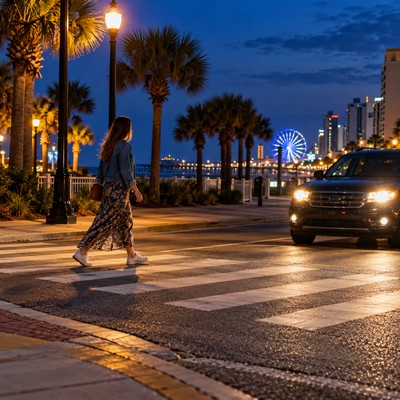
McCutchen Vaught Geddie & Hucks, P.A. helps injured pedestrians in Myrtle Beach, South Carolina, and nearby areas evaluate fault, insurance coverage, medical losses, and evidence that may become especially significant in nighttime crashes. The firm offers free consultations for personal injury matters.





Why Nighttime Pedestrian Accidents Can Be Harder to Evaluate
Pedestrian crashes after sunset often involve visibility questions that are less prominent during daylight. Streetlights, vehicle headlights, storefront lighting, curves, parked vehicles, glare, landscaping, rain, and other conditions can affect what a driver or pedestrian could reasonably see.
In Myrtle Beach, a nighttime pedestrian collision may happen near hotels, restaurants, parking areas, entertainment districts, residential streets, or heavily traveled roads. The fact that a crash happened after dark does not automatically make either the driver or the pedestrian responsible.
South Carolina law places duties on both drivers and pedestrians. Drivers must use reasonable care and follow applicable right-of-way rules. Pedestrians must obey applicable traffic-control signals, crosswalk requirements, sidewalk rules, and other roadway laws.
Liability depends on the full set of facts. Darkness, dark clothing, or crossing outside a marked crosswalk does not decide fault by itself.
When a Driver May Be Liable for a Pedestrian Accident
A driver may be negligent when the driver fails to use the level of care that a reasonably careful driver would use under similar circumstances.
Conduct that may support a claim against a driver can include:
Driving too fast for traffic, roadway, weather, or visibility conditions
Failing to watch for pedestrians in or near a crosswalk
Failing to yield when South Carolina law requires it
Driving while distracted
Driving while impaired
Failing to use headlights as required
Turning without checking for pedestrians
Passing a vehicle that has stopped for a pedestrian
Failing to react reasonably after seeing a pedestrian in the roadway
South Carolina Code Section 56-5-3130 addresses pedestrian right-of-way in crosswalks when traffic-control signals are not in place or are not operating. In those circumstances, a driver must yield, slowing or stopping if needed, when a pedestrian is crossing within a crosswalk and is on the driver's half of the roadway or is approaching closely enough from the opposite half to be in danger.
The same statute states that a pedestrian cannot suddenly leave a curb or another place of safety and walk or run into the path of a vehicle that is so close that it creates an immediate hazard. It also prohibits a driver from overtaking and passing a vehicle that has stopped at a marked crosswalk or an unmarked crosswalk at an intersection to allow a pedestrian to cross.
Nighttime claims often focus on whether the driver should have seen the pedestrian sooner. Vehicle speed, headlight condition, sight distance, reaction time, road geometry, and surrounding lighting can become central issues.
Learn more about pedestrian injury claims at:
https://lawyersatthebeach.com/myrtle-beach-pedestrian-accident-lawyers/




When a Pedestrian May Share Fault
Pedestrians also have legal duties under South Carolina law.
South Carolina Code Section 56-5-3150 provides that a pedestrian crossing a roadway outside a marked crosswalk or an unmarked crosswalk at an intersection must yield the right-of-way to vehicles on the roadway. The statute also restricts crossing between adjacent intersections with operating traffic-control signals to marked crosswalks.
South Carolina Code Section 56-5-3160 addresses where pedestrians may walk along a highway. When a sidewalk is provided and its use is practicable, pedestrians generally may not walk along the adjacent roadway. When no sidewalk is available, a pedestrian walking along a highway must use the shoulder as far from the roadway edge as practicable. When neither a sidewalk nor shoulder is available, the pedestrian must walk as near as practicable to the outside edge of the roadway and, on a two-way roadway, on the left side.
A pedestrian might be assigned some responsibility when evidence shows conduct such as:
Crossing outside a crosswalk without yielding to approaching traffic
Entering the roadway so suddenly that a driver did not have a reasonable opportunity to stop
Ignoring a pedestrian-control signal
Walking in the roadway when a usable sidewalk was available
Walking in a direction that violates applicable roadway rules
Being impaired in a way that contributed to the collision
Dark clothing may become part of an insurance company's visibility argument. Clothing alone does not determine fault. Lighting, headlights, speed, road design, traffic conditions, and the amount of time the pedestrian was visible before impact may also matter.

During this most difficult period of time in my life, Margaret Evans and the staff assisted me during my divorce. I needed legal counsel which was provided professionally and efficiently. Thank you for your prompt and courtesy service to me.
- Mark Hafenbreidel
Made the home closing process quick and easy! We appreciated their quick and clear communications, especially since our closing was over the holidays.
- Alyssa Burke
Client Reviews
See what our clients have to say about our law firm and the people who are a part of it.
How Comparative Negligence Can Affect a Pedestrian Accident Claim
South Carolina uses a modified comparative negligence system.
Under the rule adopted in Nelson v. Concrete Supply Co., an injured person may recover damages if the person's negligence is not greater than the defendant's negligence. The recovery is reduced according to the injured person's percentage of fault.
Consider a hypothetical example:
A pedestrian crosses a road outside a marked crosswalk after dark. At the same time, a driver is traveling too fast for the conditions and fails to react even though the pedestrian was visible long enough for a careful driver to respond.
Both parties could potentially share responsibility.
If the pedestrian is found 30 percent at fault and the driver 70 percent at fault, the pedestrian's recoverable damages can be reduced by 30 percent.
If the pedestrian is found 50 percent at fault and the driver 50 percent at fault, the pedestrian may still recover, subject to a 50 percent reduction.
If the pedestrian's negligence is greater than the defendant's negligence, recovery is barred.
Fault percentages depend on the evidence. An insurance company may focus on darkness, clothing, or a crossing location. Those facts should be considered together with the driver's speed, attention, reaction, visibility, and other circumstances.
What Evidence Matters After a Pedestrian Accident at Night?
Visibility disputes can make evidence preservation especially significant after a nighttime pedestrian crash.
Useful evidence may include:
Police reports and crash diagrams
Photographs of the scene
Video recorded near the time of the collision
Streetlight locations
Evidence showing whether streetlights were operating
Surveillance footage from hotels, restaurants, businesses, homes, or parking areas
Dashcam footage
Vehicle event data when available
Cell phone records when distracted driving is suspected
Witness statements
Vehicle headlight condition
Roadway measurements
Crosswalk and lane markings
Sight-distance measurements
Clothing worn by the pedestrian
Medical records
Toxicology evidence when impairment is alleged
Weather and roadway evidence when relevant
Some evidence can disappear quickly. Businesses may overwrite surveillance recordings, damaged vehicles may be repaired, roadway conditions may change, and witnesses may become harder to locate.
For broader information about injury claims, visit:
https://lawyersatthebeach.com/myrtle-beach-personal-injury-attorneys/
Can Someone Other Than the Driver Be Liable?
Some pedestrian accident claims involve parties other than the driver and pedestrian.
Depending on the facts, potentially responsible parties may include:
An employer when an employee causes a crash while acting within the scope of employment
A vehicle owner when a separate legal basis for liability applies
A property owner when a dangerous property condition contributes to the collision
A contractor whose work creates an unsafe traffic condition
A governmental entity when roadway design, signals, or maintenance are legally relevant to the claim
Claims against governmental entities can involve different procedures and deadlines. Under the South Carolina Tort Claims Act, an action is generally barred unless it is filed within two years after the loss was or should have been discovered. When a claimant first files a claim under the Act, the filing period can extend to three years under the statute. Other rules and exceptions may also affect a specific claim.
What Compensation May Be Available After a Pedestrian Injury?
A pedestrian injured because of another person's negligence may seek compensation for losses caused by the accident.
Depending on the circumstances, those losses may include:
Emergency medical treatment
Hospital care
Surgery
Physical therapy
Rehabilitation
Prescription medication
Future medical treatment
Lost income
Reduced earning capacity
Physical pain
Emotional distress
Permanent impairment
Scarring or disfigurement
Other documented accident-related expenses
There is no single formula for determining the value of a pedestrian accident claim. The value can depend on the severity of the injuries, medical treatment, recovery, ability to work, long-term effects, available insurance coverage, disputed liability, and other case-specific evidence.
How Long Do You Have to File a Pedestrian Accident Lawsuit?
South Carolina generally provides a three-year limitations period for actions involving injury to a person under Section 15-3-530.
That general rule does not apply the same way to every case. Claims involving governmental defendants and other circumstances can follow different deadlines or procedures.
A legal filing deadline is also not the only reason to act promptly. Surveillance recordings may disappear, vehicles may be repaired, road conditions may change, and witnesses may forget details.
Preserving evidence early can affect how clearly the circumstances of a nighttime pedestrian crash can be reconstructed.
What Should You Do After a Pedestrian Accident After Dark?
Medical care should come first. Pedestrian collisions can cause head injuries, fractures, internal injuries, soft-tissue injuries, and other conditions that may require prompt evaluation.
When circumstances allow:
Photograph the location, crosswalks, streetlights, signs, and surrounding roadway
Take photographs near the same time of night to document lighting and sight conditions
Save the clothing and personal items involved in the collision
Keep medical records, bills, and prescription information
Preserve wage and employment records if the injury affects your ability to work
Save photographs, videos, insurance correspondence, and witness information
Avoid giving recorded statements about fault before you understand your rights
Do not assume that you caused the crash solely because you were outside a marked crosswalk or wearing dark clothing. Those facts may be relevant, but neither fact determines liability by itself.
For more information about South Carolina pedestrian right-of-way rules, read:
https://lawyersatthebeach.com/blog/understanding-south-carolinas-pedestrian-right-of-way-laws/
Speak With a Myrtle Beach Pedestrian Accident Attorney
A pedestrian accident after dark can raise questions about visibility, right-of-way, driver conduct, shared fault, insurance coverage, medical expenses, and evidence preservation.
McCutchen Vaught Geddie & Hucks, P.A. can review the circumstances of a pedestrian collision in Myrtle Beach, South Carolina, and nearby areas, examine available evidence, identify potentially responsible parties, and explain how South Carolina law may apply.
The firm offers free consultations for personal injury matters. Contact the firm online:
https://lawyersatthebeach.com/contact-us/
This article is for informational purposes only and is not legal advice. Consult an attorney about your specific situation.