Yes. You may refuse the official chemical breath test requested after a South Carolina DUI arrest. Refusal can trigger an immediate driver’s license suspension, and the refusal may be used against you in court.
If you have no qualifying prior DUI convictions or specified license suspensions during the preceding ten years, the refusal suspension is generally six months. You have 30 days from the issuance of the suspension notice to request a contested case hearing. The license proceeding is separate from the criminal DUI case, so refusing the test does not prevent an arrest or automatically defeat the DUI charge.
McCutchen Vaught Geddie & Hucks, P.A. helps drivers in Myrtle Beach, Horry County, and nearby South Carolina communities understand the license and criminal proceedings that may follow a breath-test refusal.
A refusal creates a separate license case. The 30-day hearing deadline can expire before your first criminal court date.



What Does Refusing a Breath Test Mean in South Carolina? 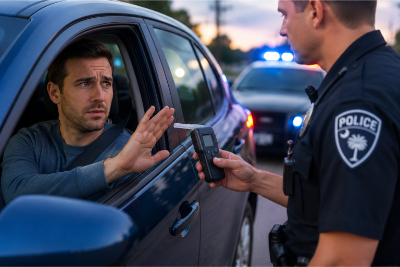
Drivers often use “breath test” to describe several parts of a DUI investigation. The distinction affects your rights and the possible consequences.
During a traffic stop, an officer may ask questions, request roadside field sobriety tests, or use preliminary screening equipment. The official chemical breath test usually occurs after arrest at a breath-testing site.
South Carolina Code Section 56-5-2950 states that a person who drives in the state is considered to have consented to chemical testing of breath, blood, or urine after an arrest for an offense arising from alleged driving under the influence.
Before testing begins, the person must receive a written copy of the implied consent rights and a verbal explanation that:
- The person does not have to take the test or provide the requested samples
• Refusal can suspend or deny driving privileges for at least six months
• The person may have the option to end the suspension through the Ignition Interlock Device Program
• The refusal may be used against the person in court
• The person may request a contested case hearing within 30 days after the notice of suspension is issued
• The person has the right to obtain additional independent testing at the person’s expense
You may refuse the post-arrest chemical breath test, but the refusal can create administrative consequences that are separate from the DUI charge.



Are Field Sobriety Tests the Same as the Official Breath Test?
No. Field sobriety tests are roadside exercises. The official breath test is a chemical test administered after arrest.
South Carolina’s DUI video statute states that refusing a field sobriety test does not constitute disobeying a police command. A separate law applies when an officer suspects that a driver caused a motor vehicle incident resulting in another person’s death. In that situation, a physically able driver must submit to field sobriety tests.
An officer may still arrest a driver who refuses roadside testing when the officer believes that other evidence establishes probable cause.
What Happens to Your License After a Breath-Test Refusal?
The arresting officer generally issues a notice of suspension. The suspension is effective beginning on the date of the alleged DUI, DUAC, or felony DUI violation.
If you have no qualifying prior DUI convictions or specified implied consent suspensions during the preceding ten years, a refusal generally results in a six-month suspension.
The suspension periods increase when the driving record contains qualifying events during the ten-year lookback period:
- Nine months for a second qualifying event
• Twelve months for a third qualifying event
• Fifteen months for a fourth or later qualifying event
Within 30 days after the suspension notice is issued, you may request a contested case hearing and choose an available driving option provided by law. Depending on the circumstances, that option may involve enrollment in the Ignition Interlock Device Program or obtaining a temporary alcohol license while the hearing is pending.
If you do not request a hearing, or if the suspension is upheld, South Carolina law may permit you to enroll in the Ignition Interlock Device Program, end the remaining suspension, and obtain an ignition interlock restricted license. The device generally must remain installed for the period required by statute.
Your notice, prior driving record, license status, and chosen hearing option can affect the available route. Review the paperwork before taking action.
A refusal can also affect an out-of-state driver. South Carolina may suspend the nonresident’s privilege to drive in the state and notify the licensing agency in the driver’s home state. The home state may take separate action under its own laws.
During this most difficult period of time in my life, Margaret Evans and the staff assisted me during my divorce. I needed legal counsel which was provided professionally and efficiently. Thank you for your prompt and courtesy service to me. Made the home closing process quick and easy! We appreciated their quick and clear communications, especially since our closing was over the holidays. See what our clients have to say about our law firm and the people who are a part of it.
- Mark Hafenbreidel
- Alyssa Burke
Client Reviews
The 30-Day Contested Case Hearing Deadline
You have 30 days from the issuance of the suspension notice to request a contested case hearing before the South Carolina Office of Motor Vehicle Hearings. Missing that deadline generally waives your right to the hearing, and the suspension continues.
For a refusal suspension, the hearing generally addresses whether:
- You were lawfully arrested or detained
• You received a written copy of the implied consent rights
• The officer verbally informed you of those rights
• You refused the requested test
The South Carolina Department of Motor Vehicles and the arresting officer have the burden of proof at the contested case hearing.
The hearing does not decide whether you are guilty of DUI. It addresses the administrative suspension. The criminal case proceeds separately in court.
Keep every page of your DUI, bond, and DMV paperwork. The date on the suspension notice controls the 30-day deadline. Your first criminal court date does not extend that deadline.
Can You Still Be Charged With DUI Without a Breath Result?
Yes. A breath result is one form of evidence. Prosecutors may rely on other evidence, including:
- The driving pattern
• The stated reason for the traffic stop
• Officer observations
• Statements made during the stop or after arrest
• Field sobriety test performance
• Open containers
• Witness accounts
• Collision evidence
• Dash-camera, body-camera, or breath-room video
Refusing the test does not erase evidence gathered before or after arrest. South Carolina law permits the refusal to be used against you in court. The defense may present the full circumstances, including confusion, medical limitations, communication problems, unclear instructions, panic, or a disputed advisement.
The State must still prove the DUI charge beyond a reasonable doubt. The absence of a breath number changes the evidence, but it does not decide the case.
Why Video From the Stop and Breath-Test Site Matters
South Carolina law requires video recording at the incident site and breath-test site in DUI, DUAC, and felony DUI cases, subject to statutory exceptions.
The incident-site recording generally must:
- Begin no later than the activation of the officer’s blue lights
• Include any field sobriety tests administered
• Include the arrest or applicable probable cause determination
• Show the person being advised of Miranda rights
The breath-test-site recording generally must:
- Include the entire breath-test procedure
• Show that the person was informed of the recording and the right to refuse
• Include the person taking or refusing the test
• Show the breath-test operator’s actions
• Include the required 20-minute pretest waiting period, unless a statutory exception applies
Video may answer questions that a written report cannot answer:
- Did the officer clearly provide the implied consent advisement?
• Did you ask questions or appear confused?
• Was the refusal clear and definite?
• Did you attempt to provide a sample?
• Did the operator follow the required steps?
• Does the video match the written report?
• Were medical or communication issues visible?
Missing video does not automatically require dismissal. South Carolina law recognizes limited exceptions and permits a court to consider other valid reasons based on the full circumstances. A DUI defense attorney can review whether the recording requirements were met and how any missing footage affects the case.
What If You Tried but Could Not Provide a Breath Sample?
Not every unsuccessful breath test is a refusal.
Asthma, lung disease, anxiety, an injured mouth, or another physical condition may affect a person’s ability to provide an acceptable sample. South Carolina law permits an officer to request a blood sample when a person is physically unable to provide an acceptable breath sample because of an injured mouth, unconsciousness, or another reason considered acceptable by licensed medical personnel.
The current South Carolina Law Enforcement Division implied consent manual also distinguishes a refusal from an “incomplete subject test.” An incomplete test, by itself, is not a refusal when the person failed to provide an acceptable sample through no fault of the person.
Evidence relevant to this issue may include:
- Medical records
• Inhaler use
• Video from the testing site
• The number and duration of attempts
• The operator’s instructions
• Statements showing a willingness to comply
• The instrument’s printed report or evidence ticket
The legal question may depend on whether the person intentionally refused, failed to cooperate, interfered with testing, or could not provide a sample for a reason outside the person’s control.
Does Refusing a Breath Test Prevent Blood or Urine Testing?
Not in every case.
South Carolina law permits urine testing when an officer has reasonable suspicion that a person is under the influence of drugs or a combination of alcohol and drugs. An officer may request a blood sample when a person is physically unable to provide an acceptable breath sample for a reason recognized by the statute.
Investigations involving serious bodily injury or death may involve other statutes, evidence, and testing issues. A standard breath-test refusal analysis should not be applied to a major-crash or felony DUI investigation without reviewing the specific facts.
What Should You Do After Refusing a Breath Test?
The hours after release can feel disorganized, especially when the stop occurred during a visit to Myrtle Beach or after a late-night drive along the Grand Strand. Focus on preserving information and protecting the deadline.
Take these steps:
- Photograph or scan the suspension notice, ticket, bond paperwork, and testing documents
• Write down the stop location, timeline, instructions, and your exact response
• Preserve receipts, text messages, location history, and witness information
• Record any medical condition, medication, injury, language issue, or anxiety symptoms
• Do not post about the stop, refusal, or alcohol use on social media
• Do not assume that the criminal court date protects the 30-day administrative deadline
• Speak with a South Carolina DUI defense attorney promptly
For a broader explanation of DUI representation, review:
https://lawyersatthebeach.com/myrtle-beach-dui-attorneys/
For more information about South Carolina DUI charges, review:
Drivers facing a first charge may also review:
https://lawyersatthebeach.com/blog/first-time-dui-charges-in-south-carolina-what-are-your-options/
How Can a Myrtle Beach DUI Attorney Help?
A DUI attorney can address the license proceeding and criminal case as separate matters while reviewing evidence that may affect both proceedings.
The review may include:
- The legality of the traffic stop
• Probable cause for arrest
• The written and verbal implied consent warnings
• Dash-camera, body-camera, and breath-room video
• Medical or physical limitations
• The instrument report and testing records
• Operator certification and breath-site records
• Prior driving history
• The accuracy of the suspension notice
• Whether the hearing request was filed on time
Counsel can request a contested case hearing, explain the available temporary driving and ignition interlock options, obtain discovery, preserve recordings, question witnesses, negotiate with the prosecutor, and prepare motions or trial defenses when supported by the evidence.
Related information is available at:
https://lawyersatthebeach.com/myrtle-beach-criminal-defense-lawyers/
The post-arrest guide is available at:
Speak With a Myrtle Beach DUI Defense Attorney
A breath-test refusal can create an immediate license issue before the criminal case reaches court. Early legal review can help you identify the correct deadline, preserve video and records, and determine whether the refusal or suspension can be challenged.
McCutchen Vaught Geddie & Hucks, P.A. offers free consultations for DUI and criminal defense matters. Call 843-277-1667 or visit:
https://lawyersatthebeach.com/contact-us/
The firm assists clients with South Carolina DUI stops, breath-test refusals, suspension notices, and related criminal defense matters in Myrtle Beach, Horry County, and nearby areas.
This article is for informational purposes only and is not legal advice. Consult an attorney about your specific situation.