Yes, you can be charged with DUI on a golf cart in South Carolina if law enforcement believes you were driving a motor vehicle while impaired. South Carolina DUI law focuses on whether alcohol, drugs, or a combination of substances materially and appreciably impaired your ability to drive. Golf carts are also regulated under South Carolina motor vehicle laws when operated on public highways, including rules about permits, licensing, insurance, location, speed limits, and local ordinances. A DUI accusation involving a golf cart in Myrtle Beach may depend on where the cart was driven, whether the officer observed the operation, whether testing was handled properly, and whether the cart was being used in a lawful area.





Can You Get a DUI on a Golf Cart in South Carolina? 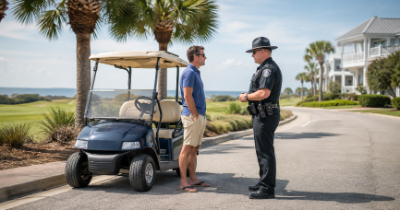
Many people think of a golf cart as a neighborhood or resort vehicle, not a car. That assumption can lead to serious trouble. In South Carolina, DUI law does not only apply to traditional passenger cars and trucks. The statute makes it unlawful to drive a motor vehicle while under the influence of alcohol, drugs, or a combination of substances when the person’s faculties to drive are materially and appreciably impaired.
That means a golf cart DUI charge may arise when police believe a person operated the cart while impaired. In Myrtle Beach, North Myrtle Beach, Surfside Beach, Garden City, resort communities, campgrounds, golf course areas, beach neighborhoods, and private communities, golf carts are common enough that law enforcement takes their operation seriously.
A golf cart may feel slower and less dangerous than a full-size vehicle, but the legal risk can still be significant. A DUI arrest can affect your license, court record, insurance, employment, and ability to travel freely while the case is pending.
Why Golf Cart DUI Cases Happen in Myrtle Beach
Myrtle Beach has a unique mix of tourists, locals, golf communities, resorts, restaurants, beach access roads, and neighborhoods where golf carts are often used for short trips. During busy travel seasons, people may use a cart to move between rental homes, local shops, parking areas, beach paths, and community entrances.
Common scenarios include:
- A driver leaves a restaurant or bar and takes a golf cart back toward a rental home.
- Police stop a golf cart near a beach access area after dark.
- An officer sees a cart crossing or traveling near a public street.
- A minor collision happens in a resort, campground, neighborhood, or parking area.
- A passenger is injured after falling from a moving cart.
- A cart is stopped because it lacks lights, insurance documentation, a permit, or proper registration paperwork.
- The driver assumes that a short trip does not count as “driving” for DUI purposes.
The legal issue is not whether the trip was short. The issue is whether the State can prove the required elements of the offense.
How South Carolina Regulates Golf Carts
South Carolina law has specific rules for operating golf carts on public highways. Under Section 56-2-90, an owner must obtain a permit decal and registration certificate from the Department of Motor Vehicles to operate a golf cart on a public highway. The operator must be at least sixteen years old, have a valid driver’s license, and carry the registration certificate, proof of liability insurance, and driver’s license.
The law also allows municipalities and counties to regulate hours, methods, and locations of golf cart operation. Golf carts may be operated only on highways with speed limits of 35 miles per hour or less. Local ordinances may also permit nighttime operation if the cart has working headlights and taillights. In the absence of a local ordinance, permitted golf carts generally may be operated only during daylight hours, on certain roads with speed limits of 35 miles per hour or less, and within the location limits set by the statute.
These golf cart rules matter in a DUI case because they may affect the reason for the stop. For example, an officer may initially stop a cart for an equipment, time-of-day, license, insurance, or location issue. Once the officer begins speaking with the driver, the encounter may shift into a DUI investigation if the officer claims to smell alcohol, notice slurred speech, observe poor coordination, or see signs of drug impairment.





What Prosecutors May Need to Prove
A golf cart DUI case is still a DUI case. The State must prove its allegations beyond a reasonable doubt. In general, the prosecution may focus on whether:
- The accused person was driving or operating the golf cart.
- The golf cart qualifies as a motor vehicle for purposes of the charge.
- The operation happened in South Carolina.
- The person was under the influence of alcohol, drugs, or both.
- The impairment materially and appreciably affected the person’s ability to drive.
- The officer had a lawful basis for the stop, detention, arrest, and testing.
Each fact matters. If officers did not see the person drive, the case may depend on witness statements, video, location evidence, admissions, or circumstantial proof. If the cart was found parked, the State may need to connect the accused person to actual operation. If the alleged impairment was based on observations alone, the defense may examine whether fatigue, heat, nerves, injury, medical conditions, or beach-day exhaustion affected the officer’s interpretation.
Does It Matter If the Golf Cart Was on Private Property?
Location can matter, but it does not automatically make the charge disappear. A golf cart DUI allegation may begin on a public street, a resort road, a private community road, a campground path, a parking lot, or a golf course area. The defense should examine where the alleged driving occurred, who controlled the property, whether the public could access it, and whether the officer had authority to stop and investigate.
Private property facts may create defense arguments in some cases. They can also affect whether other charges or local ordinance violations are alleged. A person should not assume that “private property” ends the case. The police report, body camera video, 911 call, witness statements, and property layout may all need review.
During this most difficult period of time in my life, Margaret Evans and the staff assisted me during my divorce. I needed legal counsel which was provided professionally and efficiently. Thank you for your prompt and courtesy service to me. Made the home closing process quick and easy! We appreciated their quick and clear communications, especially since our closing was over the holidays. See what our clients have to say about our law firm and the people who are a part of it.
- Mark Hafenbreidel
- Alyssa Burke
Client Reviews
Golf Cart DUI Stops and Chemical Testing
South Carolina implied consent law states that a person who drives a motor vehicle in the state is considered to have given consent to chemical tests of breath, blood, or urine if arrested for an offense arising from acts allegedly committed while driving under the influence. The statute also includes procedures for breath, blood, and urine testing, including timing and certification requirements.
In a golf cart DUI case, testing issues can become central. A defense attorney may look at:
- Whether the officer had probable cause to arrest.
- Whether the breath test was offered and administered correctly.
- Whether the testing machine and simulator check complied with procedures.
- Whether a urine or blood test was requested lawfully.
- Whether the driver was advised of rights and consequences.
- Whether video evidence supports or contradicts the officer’s report.
- Whether the reported alcohol concentration fits the timeline.
Testing evidence is not always the whole case. A person may face a DUI charge based on alleged impairment even if there is no breath result, no blood result, or a result that the defense can challenge.
Common Defense Issues in a Golf Cart DUI Case
No two cases are identical, but several issues often deserve close review.
First, the stop may be challenged. An officer usually needs a lawful reason to stop or detain someone. If the stop began because of golf cart rules, the defense may examine whether the officer correctly understood the applicable law or local ordinance.
Second, operation may be contested. If police found the person near a parked cart, sitting in a cart, or standing nearby after a crash, the State may need more proof that the person actually drove.
Third, impairment may be disputed. Field sobriety tests can be affected by uneven pavement, sandals, heat, stress, medical conditions, age, fatigue, or poor instructions. In a beach community, sand, humidity, dehydration, and long days outside can also affect how a person looks and performs.
Fourth, video may matter. Body camera, dash camera, business security video, resort surveillance, and phone videos may show what happened before, during, and after the stop.
Fifth, the golf cart itself may raise questions. Was it permitted? Was it operating on a lawful road? Did it have required lights? Was it within a local ordinance zone? These facts may not decide the DUI issue alone, but they can shape the stop and the defense strategy.
What Penalties Can Follow a DUI Conviction?
A DUI conviction in South Carolina can carry fines, jail exposure, license consequences, Alcohol and Drug Safety Action Program requirements, increased insurance costs, and a criminal record. The exact exposure depends on the facts, the person’s record, test results, and the charge level.
A first offense is serious even when no one was hurt. If there is a collision, injury, child passenger, high alcohol concentration, refusal issue, or prior record, the stakes may become higher. A golf cart DUI should not be treated as a minor misunderstanding simply because the vehicle was small.
What You Should Do After a Golf Cart DUI Arrest
After an arrest, avoid trying to talk your way out of the charge. Statements made to officers, court staff, insurance companies, property managers, or witnesses may be used later.
Practical steps include:
- Write down where you were, where the cart was, and who was present.
- Save photos of the location, road signs, lighting, cart path, parking area, or community entrance.
- Preserve ride records, receipts, text messages, or GPS information.
- Identify passengers or witnesses.
- Do not post about the arrest on social media.
- Request copies of court paperwork and bond conditions.
- Speak with a defense attorney before entering a plea.
For more information about DUI defense, visit https://lawyersatthebeach.com/myrtle-beach-dui-attorneys/. If the case also involves other criminal allegations, the broader criminal defense page at https://lawyersatthebeach.com/myrtle-beach-criminal-defense-lawyers/ may be helpful. The firm also provides guidance on arrest-related mistakes at https://lawyersatthebeach.com/7-costly-mistakes-to-avoid-if-youve-been-arrested-in-south-carolina/.
Why Local Legal Guidance Matters
A golf cart DUI in Myrtle Beach can involve state DUI law, local ordinances, tourism-related facts, neighborhood access issues, resort policies, and law enforcement procedures. A case in a beach rental area may look different from a case in a gated community, golf course, campground, or public street near Ocean Boulevard.
An attorney can review the stop, the route, the property, the video, the test evidence, and the officer’s report. The goal is not to rely on assumptions. The goal is to identify what the State can prove, what it cannot prove, and what options may fit the facts.
You can learn more about the firm’s team at https://lawyersatthebeach.com/our-attorneys/ and read client feedback at https://lawyersatthebeach.com/reviews/.
Speak With a Myrtle Beach DUI Defense Lawyer
A DUI charge involving a golf cart can feel embarrassing, confusing, and unexpected. You may be worried about your license, your job, your family, your record, or your next court date. You do not need to guess your way through the process.
McCutchen Vaught Geddie & Hucks, P.A. represents people facing DUI and criminal charges in Myrtle Beach and across South Carolina. Contact the firm to request a free consultation and discuss what happened in a private setting.
This article is for informational purposes only and is not legal advice. Consult an attorney about your specific situation.